The Perfect Crosswind Landing Technique
Mastering a truly safe final approach demands immense physical coordination. The ultimate test of flying skill arrives when a pilot attempts a crosswind landing. Managing a strong gusty crosswind component requires breaking natural instincts. Instead of coordinated turns, a perfect crosswind landing forces the aviator to explicitly cross their controls, separating the rudder input from the aileron deflection. This dedicated crosswind landing technique allows the aircraft to track straight down the asphalt while successfully battling strong sideways air currents.
Key Takeaways
- A crosswind landing requires separating rudder and aileron inputs to eliminate lateral drift.
- The crab procedure points the nose into the wind, translating into a straight path over the physical ground.
- The wing-low methodology banks the aircraft to stop lateral movement while pressing the rudder to align the nose straight forward.
- Every certified aircraft features a specific demonstrated crosswind component limit.
Table of Contents
The Aerodynamics of a Crosswind Landing
A linear approach presents zero lateral complexity. However, a sweeping crosswind landing forces an incoming aircraft to combat an invisible moving mass of air pushing firmly across the landing zone. In fluid dynamics, an airplane moving through a blowing wind acts identically to a boat drifting across a fast-flowing river. If the pilot fails to apply the proper control input, the machine slips toward the grass.
To safely stop this sideways movement, known as lateral drift, the pilot must align the flight path directly with the runway centerline. The wind speed and direction determine the necessary crosswind component. Professional aviators accomplish this through distinct crosswind techniques: maintain a crab or transition to a sideslip.
The physics of this landing depends on resolving vectors. You use the aileron to control your position over the ground and the rudder to align the nose of the plane. Without separating these inputs, you cannot achieve a stabilized approach.
Executing the Stabilized Crab Method
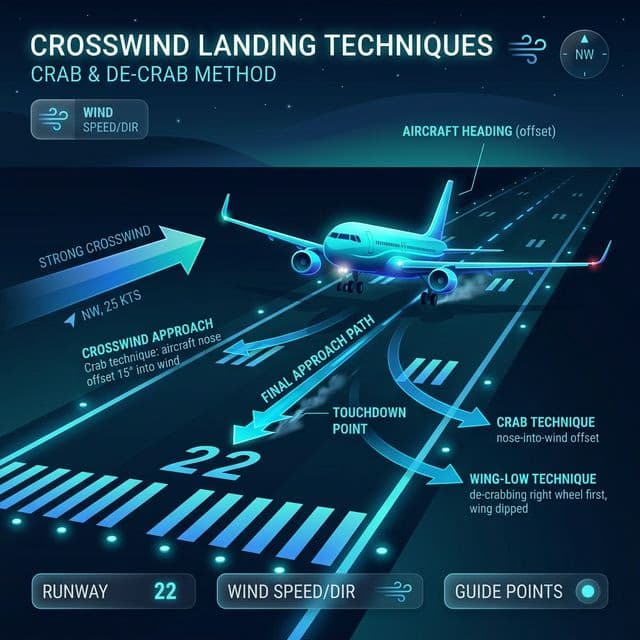
Airline transport crews generally prefer the crab method for the initial portion of the approach. In this crab technique, the pilot points the nose directly into the wind. This allows the airplane to fly straight down the runway while the nose is actually offset by several degrees.
By flying aligned with the runway but in a crab, you maintain a coordinated flight state. This is more comfortable for passengers and easier to manage at high altitudes. However, a pure crab cannot be maintained through touchdown. Landing in a crab would place immense sideloads on the landing gear, potentially leading to structural failure.
Employing full flaps significantly slows the landing speed. A slower indicated airspeed reduces the available authority residing in the flight controls. Pushing a final approach through a powerful gale often requires flying with partial flaps. Flying extremely fast increases the flight control bite needed to align the nose with the runway safely. You rely on comparing the runway heading with the reported incoming wind to confirm your performance operating margins.
Deploying the Wing-Low Sideslip
The wing-low method is fundamentally different. Instead of crabbing, the pilot purposefully slips the airplane into the wind. This is often considered the preferred crosswind landing technique for smaller general aviation aircraft because it provides a more stable picture during the flare.
To initiate the wing-low slip, you drop the upwind wing. This creates a lateral force that counteracts the wind's push. Aileron pressure is adjusted to stop the drift. As the wind varies, the pilot must increase or decrease the bank angle to stay centered.
Simultaneously, you must rudder to keep the nose pointed straight. This creates a "cross-controlled" state where the longitudinal axis of the airplane is parallel to the runway centerline, but the wings are banked. Using the rudder to keep the nose straight is the key to a safe arrival.
The Flare and Touchdown
The most critical moment occurs during the flare. The pilot must keep the nose aligned while simultaneously slowing the aircraft. As the airspeed drops, the flight controls become less effective, requiring larger movements of the aileron and rudder.
In a wing-low landing, the touchdown should occur on the upwind main wheel first. This is the hallmark of a perfect crosswind landing. By landing on one wheel, you maintain the corrective bank right until the moment of contact, ensuring the plane does not drift sideways as it settles.
Once the first wheel is down, the pilot must avoid the temptation to neutralize the controls. Keep the nose aligned with the runway as the other wheels touch. The aileron should be held into the wind during the rollout to prevent the wind from lifting the upwind wing and causing a ground loop.
Safety Margins and Aircraft Capability
The official factory flight manual prominently publishes the absolute demonstrated crosswind number. This metric represents the highest safely tested wind parameter that the manufacturer's official test pilot successfully managed without risking structural damage. This capability does not represent the physical aerodynamic breaking point, but it establishes a hard standardized safety framework. A new pilot must rigidly establish hard personal limits vastly lower below this published factory baseline figure until they gain deep intense physical experience.
A pilot must respect these figures. If the crosswinds at the airport exceed your limits, or even your personal comfort level, you should look for a different runway. Safety in aviation is built on recognizing when the conditions outweigh the maneuver capability of the operator.
Consistent practice of both the crab and wing-low techniques is essential. By understanding the rudder and aileron relationship, you can master any maneuver. Always remember to keep the nose aligned, stay nose aligned with the runway, and fly the plane all the way to a full stop.
Frequently Asked Questions
What is the best technique for a crosswind landing?
Most instructors recommend the wing-low method for the final portion of the landing, as it keeps the nose aligned with the runway naturally and allows for a one-wheel touchdown that prevents drift.
How much crosswind can my aircraft handle?
Check your POH for the demonstrated crosswind value. This is the benchmark for your crosswind capability. Remember that gusty conditions often make the effective wind much higher than the reported average.
Why do I need to keep the aileron into the wind after landing?
After touchdown, the wind can still lift the upwind wing. Holding the aileron into the wind keeps the weight on the tires and prevents the airplane from tipping or weathervaning off the runway.