Quick Crosswind Calculation: The Clock Method Runway Calculator
When flying an approach, heavily relying strictly on an online crosswind calculator can dangerously distract a pilot. Pilots require an instant mental calculation technique correctly named the clock method. This historically proven aviation strategy directly replaces any digital exact calculator by smoothly converting mechanical angular differences directly into simple mathematical minute fractions cleanly on a visual clock face. By strongly visualizing the face of an analog clock, any pilot can instantly perform rapid crosswind calculations purely in their head. The ultimate aviation goal remains identically simple: definitively calculate the exact lateral sideways cross wind component perfectly before initiating any landing sequence down the runway.
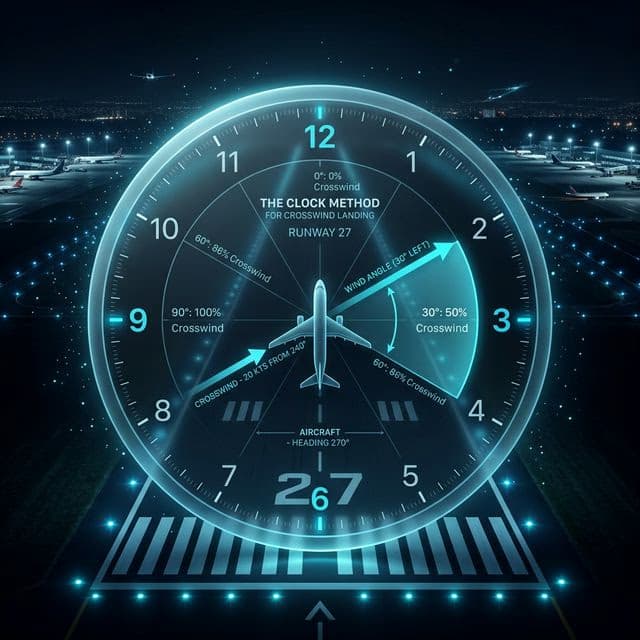
Key Takeaways
- A visual clock face provides simple fractional math to quickly calculate the crosswind component reliably in flight.
- At carefully measured 60 degrees (60 minutes) or greater, the crosswind component exactly equals the total pure wind speed.
- At 30 degrees (30 minutes), you simply multiply your speed by exactly one half (the sine of 30 degrees).
- The final computed number determines if the incoming wind safely exceeds your aircraft maximum demonstrated crosswind rating limits.
Table of Contents
Step 1: Establish the Intercept Angle
Before applying any direct calculation, you must determine the absolute angular difference separating the formal runway heading and the exact local broadcast wind direction. This is the foundation of any safe navigation effort. While a digital calculator gives you decimals, the mental model needs a round number.
Firmly subtract the assigned runway from the reported wind direction. For example, if you are landing on Runway 09 (090 degrees) and the tower reports the wind from 120 degrees at 20 knot, your intercept angle is 30 degrees. This specific integer is what you will "pin" to your mental clock.
Step 2: Map the Angle to the Clock Face
Now, visualize an analog clock face. Each minute on the clock represents one degree of wind angle. This is where the clock method becomes extremely efficient for a busy pilot. In this system, 60 minutes represents a 90-degree cross wind (full component).
- 15 Minutes (15 Degrees)One quarter (0.25) of the Wind Speed
- 30 Minutes (30 Degrees)One half (0.50) of the Wind Speed
- 45 Minutes (45 Degrees)Three quarters (0.75) of the Wind Speed
- 60 Minutes (60 Degrees+)Full (1.00) Wind Speed
By using these fractions, you can calculate the crosswind without reaching for a device. If the angle is 30°, you take half. If it is 15 degrees, you take a quarter. If the angle exceeds 60 degrees, for aviation safety, we assume the full velocity of the wind is acting as a crosswind.
A Practical Crosswind Calculation Example
Let's walk through a scenario every pilot encounters. You are on navigation for an airport with Runway 27. The wind is reported at 300 degrees at 16 knots.
- Difference: 300 - 270 = 30 degrees.
- Clock mapping: 30 degrees = 30 minutes. 30 minutes is halfway around the clock.
- Fraction: 1/2 of the reported wind speed.
- Final Calculation: 16 knots / 2 = 8 knots of crosswind.
This result tells you instantly if you can expect a significant crab angle on final. If your aircraft has a 12-knot limit, an 8-knot component is well within safe operating margins. This calculation was performed in less than three seconds.
Determining Headwind and Tailwind Components
While the crosswind component is vital for lateral control, the headwind or tailwind determines your ground speed and landing distance. You can use a similar "reverse clock" logic, or simply remember that for small angles (less than 30 degrees), almost all of the wind is a headwind.
For an angle of 0 degrees, the headwind is 100%. At 60 degrees off the nose, the headwind is roughly half the total speed. Knowing how to calculate crosswind often makes estimating the headwind redundant, as crosswind is usually the limiting safety factor.
The Sine Logic: Why the Clock Method Works
Many pilots wonder why 30 minutes equals 50 percent. This is rooted in basic trigonometry. The crosswind component is found by multiplying the total speed by the sine of the angle.
- Sine of 30 degrees = 0.5 (Hence, 1/2 of the speed).
- Sine of 45 degrees = 0.707 (Hence, ~3/4 of the speed).
- Sine of 60 degrees = 0.866 (Hence, nearly 100% of the speed).
The clock face simplifies these crosswind calculations by rounding them to easily divisible fractions that most pilots can manage while flying the aircraft.
Safety Margins and POH Limits
It is important to remember that the calculation result is a static estimate. Real-world wind is gusty and unpredictable. If your calculate crosswind result is close to your personal minimums or the aircraft's demonstrated capability, you should consider a go-around.
A crosswind calculation for pilots should always include a "buffer." If the math says 10 knots and your limit is 12, those 2 knots can disappear instantly during a gust. Use the clock method to stay self-aware, but trust your eyes and the feel of the controls above all else.
Frequently Asked Questions
Is the clock method accurate enough for aviation?
Yes. While not as precise as a digital calculator, it is accurate within a few knots. In aviation, situational awareness and timely decision-making are more important than decimal-point precision.
Can I use this for tailwinds?
Absolutely. If the wind is coming from more than 90 degrees off the nose, use the same math to calculate the tailwind component. If you have a tailwind, your landing distance will increase significantly.